I recently returned from the annual conference on sports chaplaincy, held by Sports Chaplaincy – United Kingdom (or SCUK). The two day conference centered on the growing issue of Mental Well-being in Sport and there was a tremendous amount of attention on the players and coaches with a view to how the pressure of sport is impacting to the social, spiritual, mental, and other aspects of life.
Aside from the main conference, though, was an undercurrent, a subtext. Even from the beginning of the conference, the issue of chaplaincy standards and accountability was an issue that was brought to the table. In all other types of positions and places, there are standards of excellence that usually accompany and accredit one to work in a particular position or field. For example, coaches in sport (esp. soccer) can coach to a certain level with certain credentials – certifications and badges are required to coach at the higher levels (in addition to life experience and other things). So, too in healthcare – nurses have varying degrees of skill and their pay and position are dependent upon the level of training and education that they have. Those levels also help to determine benefits, as well as to limit consequences for things like negligence by providing a structure for accountability.
Currently, SCUK in partnership with the University of Gloucestershire, are developing a program for chaplaincy education and training – but not just any chaplaincy training, rather one specific to sport. Currently, the program is among one of the first of its kind in the Western World. Stateside, Baylor University announced last year that it was beginning work toward the development of graduate program with a similar emphasis.
Although these programs are really just beginning, there is a lot to build on as chaplaincy has had a long legacy – especially in healthcare and the military. But one critical issue yet to be addressed is that of standardization. In healthcare and the military, there are basic standards that must be met – ordination with a recognized religious body, Master of Divinity or similar equivalency, Clinical Pastoral Education (CPE), Board Certification from a recognized organization (ACPE or CPSP) are among some of the standards for chaplains in those fields currently.
While a specific training track for chaplains in sport will be helpful to address the unique context and challenges that are faced, it still stands to reason – what will be done with those teams, clubs, and organizations that currently have a “chaplain” that may or may not have the education, training, or accreditation that is currently being developed?
In the United States, there are few chaplains associated with professional sport that are actually paid by the club or organization. Most “chaplains” have not had chaplain specific training, but are usually associated with Christian organizations with a primary focus on Christian evangelism and discipleship. Not bad things, but definitely not “chaplaincy” as it is currently known and understood today.
There are some instances where chaplaincy training might be helpful in avoiding certain situations like the one the chapel leader for the Washington Nationals was involved with in 2005. But it remains to be seen if the development and education structures for sports chaplaincy will take root for the other simple fact that it is rare for professional sports chaplains to change much – once a team develops trust and relationship with a chaplain, there is usually a longevity to the relationship (at least at the professional levels). And if there is really no pay for those working in professional sport, will there be much interest in investing graduate level money and time into the vocational training?
While there are still many questions similar to the ones I raise that need to be answered, I do believe that we are seeing movement in a positive direction. Personally, I am thankful for having a broader understanding and training as a chaplain which allowed me flexibility to be a chaplain in hospice and to translate much of my training into the professional sports environment. I am looking forward to seeing how education for sports chaplains develops in the coming years and I think that it speaks well for the future of sports chaplaincy to see some education and accreditation structure and standards being developed. In the coming years it is my hope and desire that CrossTraining will be able to be at the forefront of many of these changes.
Blessings,

Rev. Brad Kenney
 As I watched the game-changing event unfold, I thought, “Good finish” and told the team as much in my weekly e-mail to them. That phrase (common amongst soccer fans) though made me stop and reflect on what it means and what it looks like to finish well. Not just by putting the ball in the back of the net on a soccer pitch, but in the course of our everyday life.

 I keep the incident in my mind to remind me of something very important (and it serves to somewhat answer the question above): as team chaplain, my main job and task is not to strike a ball like the pros that I serve. My role is to be the representative, the very presence of God to the players, coaches, staff and their families. My devotion and work is not to see how well I can compete with professional players – there is a reason they are professionals. My role is to be the best pastor, minister, chaplain, counselor, etc. that I am called to be as team chaplain. I would rather be able to pray well over a person or situation. I would rather be attuned to the emotional and spiritual needs of the athletes, coaches, staff members, and their families. These are the things that I have been made for and called to do – the ways that I can best serve.
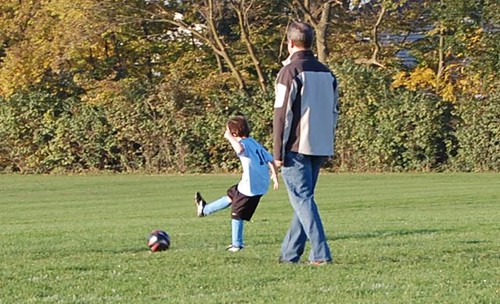 A second consideration around youth soccer is the investment that a person and family makes. There is travel time, practice time, game time, injuries, fees, uniforms, and equipment expenses – none of these may be overwhelming at first glance, but here is where the consideration of the family must take place. Our family values gathering around the dinner table and sharing a meal, talking about our day, being together – this is more difficult when you and your child are leaving the practice fields at 6:30 or later at night. While soccer might be something that an individual plays, it has an impact on more than just the individual and each family must evaluate the cost.
 Finally, and perhaps most grieving for me, from where I have been as chaplain for these many years, I have seen personally the devastation in people’s lives when they forsake God for the god of soccer. I have watched parents and players alike, become addicted to the drug of sport. And usually family life, church, and spiritual life are the casualties. The emphasis on the physical training and the physical pursuit of the sport trumps the spiritual. In the end, when soccer fails to produce what people so eagerly want to achieve, there are spiritual skeletons that limp through life. Now, this is not true of all parents and children who put their children into youth sports – but for those without regard or consideration for how youth sport impacts faith and family it is certainly a dangerous threat.


 The recent

 For example, one ancient act for demonstrating a covenant relationship was the exchange of coats. Here, two individuals would exchange their cloaks which were the symbol of their identity with a particular tribe or group of people. The dyes, colors, and patterns would have been common amongst those people and so when the two exchanged the cloaks it was a way to signify that each was accepting, embracing, adopting the identity of the other. It was a sign of solidarity, a sign of commitment. This is perhaps best illustrated by the exchange of jerseys that occurs after a match, but the supporters and fans also participate in this show of commitment. The wearing of team colors – whether shirts or scarves – are a way of trading their own, personal identity for the identity of the team.
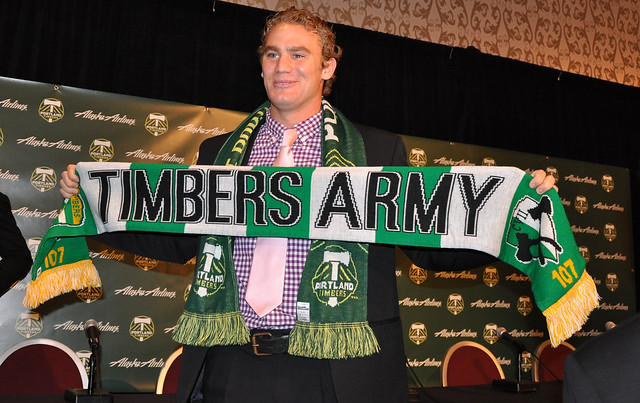 Another ancient tradition in covenantal relationship is the exchange of names. Here, an individual also takes on another identity. In ancient Hebrew tradition, the name for God was often added to the name of an individual who embraced or believed in God. For example, Abram becomes Abraham and Sarai becomes Sarah as they enter into covenant relationship with God. It is not uncommon to hear supporters in the stands declaring that they are part of the team, that they are one with the players that are out on the field. The scarf is an item that also becomes an adoption of a unique name that unifies individuals into a common people.
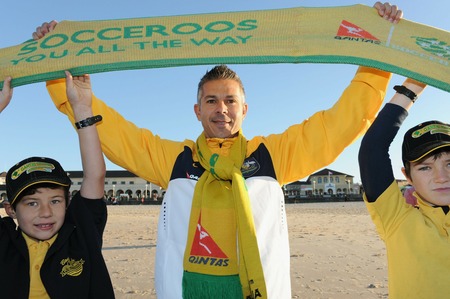 But perhaps the most telling ancient tradition that most closely represents the tradition of the scarf is the covenant cut. In ancient times, two people making a blood covenant, would make a cut on the wrist. They would then shake hands and let the blood co-mingle representing that two lives were becoming one. As time passed, the way that one would identify people of the covenant would be with the raise of the hand which revealed the scar. This is where the practice of waving the hand and exposing the wrist in greeting and also in oath-taking may have evolved from.