
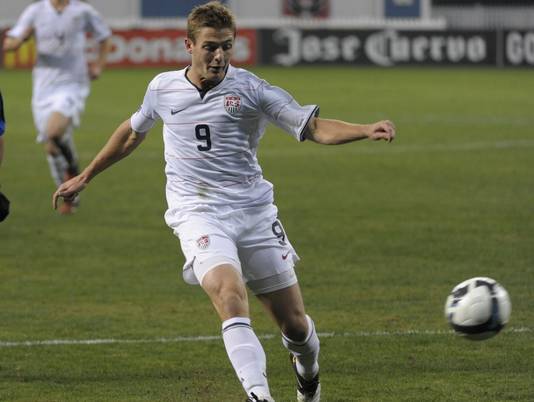
 The recent blog posting by American forward Robbie Rogers, who has stepped back from football, announced that he was gay. In a moving post that has been tweeted and mentioned by many in the soccer world, Rogers wrote of the pain of the secrecy that he has had to live with and the difficulty of telling and explaining to his loved ones after 25 years. Soccer, for Rogers, became an escape and a way to hide his secret – but one can sense the pain with which Rogers wrote. He describes seemingly religious attitudes prevalent as he writes, “Try convincing yourself that your creator has the most wonderful purpose for you even though you were taught differently.”
 Whilst Rogers didn’t state firmly that he is retiring, that he is stepping away from football is stated within the post. Rogers isn’t exactly a no-name in the sport, either. He played one year at Maryland before turning pro and playing in the Dutch Eredivise for a year. His return to Major League Soccer and time spent with the Columbus Crew he helped lead the club to a MLS championship in 2008. Rogers left Columbus to play for English side Leeds United AFC. Rogers also played for the United States Men’s National Team, scoring a goal against Mexico in a 2011 friendly.
 Rogers’ announcement is vaguely reminiscent of Justin Fashanu, who played football in England and openly admitted his homosexuality in 1990; though, perhaps without the tabloid aura surrounding his announcement. Commentary on Fashanu suggests that there was a serious burden which resulted from his announcement and the subsequent response from family. He committed suicide in 1998 after allegations of sexual assault.
Rogers’ “coming out” cannot simply be ignored by the chaplains working in sport, today. There is a real need for those who are working and ministering to clubs and athletes to develop a healthy conversation around ministry to the gay athlete as it perhaps will become increasingly commonplace in the world of sport. The conversation to be had must include best thinking on ministry praxis and the balance between theological truth and pastoral care. An announcement of this kind does not simply happen in a vacuum – there are many people affected – from family, friends, to teammates and fans. There will be some who want to use such an announcement to promote a particular agenda (and from many different sides, not just singularly). All of this comes at the expense of the person at the center.
In their classic book, Pastoral Care in Historical Perspective, William Clebsch and Charles Jaekle identify four functions of pastoral care – healing, guiding, reconciling, and sustaining. To be sure, there are applications for each function in situations such as the announcement that Rogers puts forth. Several mentions of “creator” in his blog post suggest some familiarity or acceptance of God or a “higher being” and most likely some experience with Christianity. But, an analysis of the blog text suggests a wounding coming from the church. As with Rogers and many others, there may be some serious barriers for how a chaplain might be received and whether a chaplain might convey well the love of God – especially in the American context where the issue of homosexuality is so polarizing and paralyzing amongst the different strains of fundamental, and liberal, and evangelical Christianity.
Please pray for those working with athletes in sport – as we engage in these and other difficult conversations. The environment of ministry is ever changing and as representatives of God, chaplains in sport must be prepared and ready, in season and out of season to be the best representatives and ambassadors to a world that is hurting and carrying so much pain. And God willing and empowering, we will do so.
Blessings,

Rev. Brad Kenney


 As I watched the game-changing event unfold, I thought, “Good finish” and told the team as much in my weekly e-mail to them. That phrase (common amongst soccer fans) though made me stop and reflect on what it means and what it looks like to finish well. Not just by putting the ball in the back of the net on a soccer pitch, but in the course of our everyday life.

 I keep the incident in my mind to remind me of something very important (and it serves to somewhat answer the question above): as team chaplain, my main job and task is not to strike a ball like the pros that I serve. My role is to be the representative, the very presence of God to the players, coaches, staff and their families. My devotion and work is not to see how well I can compete with professional players – there is a reason they are professionals. My role is to be the best pastor, minister, chaplain, counselor, etc. that I am called to be as team chaplain. I would rather be able to pray well over a person or situation. I would rather be attuned to the emotional and spiritual needs of the athletes, coaches, staff members, and their families. These are the things that I have been made for and called to do – the ways that I can best serve.
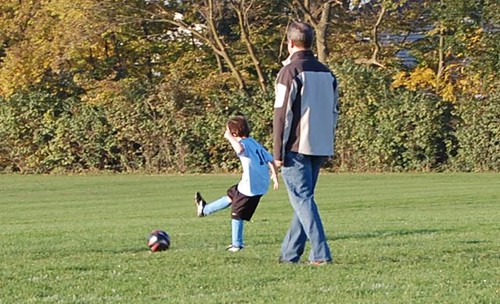 A second consideration around youth soccer is the investment that a person and family makes. There is travel time, practice time, game time, injuries, fees, uniforms, and equipment expenses – none of these may be overwhelming at first glance, but here is where the consideration of the family must take place. Our family values gathering around the dinner table and sharing a meal, talking about our day, being together – this is more difficult when you and your child are leaving the practice fields at 6:30 or later at night. While soccer might be something that an individual plays, it has an impact on more than just the individual and each family must evaluate the cost.
 Finally, and perhaps most grieving for me, from where I have been as chaplain for these many years, I have seen personally the devastation in people’s lives when they forsake God for the god of soccer. I have watched parents and players alike, become addicted to the drug of sport. And usually family life, church, and spiritual life are the casualties. The emphasis on the physical training and the physical pursuit of the sport trumps the spiritual. In the end, when soccer fails to produce what people so eagerly want to achieve, there are spiritual skeletons that limp through life. Now, this is not true of all parents and children who put their children into youth sports – but for those without regard or consideration for how youth sport impacts faith and family it is certainly a dangerous threat.


 The recent