
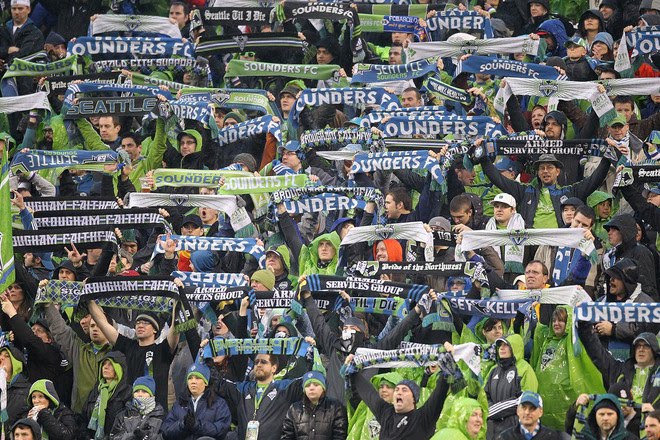
 There is a unique activity that happens in a football (soccer) match as the supporters or fans of a particular club or team will stand and raise scarves that bear their team’s colors and emblems. The practice, begun in the early 1900’s in England, was a way of showing team spirit and support in the midst of cold weather. English fans would stand, raise their scarves, sing songs and anthems about their teams and show support in this unified way. The practice has migrated not only to the US, but really worldwide as teams today in climates hot and cold, produce team scarves as a way for fans to show their loyalty. Scarves can vary – but the most traditional forms feature alternating team color stripes. Some feature team crests or logos as well as names. Some scarves are made for special fixtures or games. And other scarves even have player pictures and likenesses.

While many may be familiar with the history of the scarf, the tradition might have even a longer reaching history than 20th century England. In ancient times, there were several ways that a person might physically and tangibly demonstrate that they were in a covenant relationship with someone, especially with God. The similarities between these ancient practices and the raising of the scarf are amazing to consider.
 For example, one ancient act for demonstrating a covenant relationship was the exchange of coats. Here, two individuals would exchange their cloaks which were the symbol of their identity with a particular tribe or group of people. The dyes, colors, and patterns would have been common amongst those people and so when the two exchanged the cloaks it was a way to signify that each was accepting, embracing, adopting the identity of the other. It was a sign of solidarity, a sign of commitment. This is perhaps best illustrated by the exchange of jerseys that occurs after a match, but the supporters and fans also participate in this show of commitment. The wearing of team colors – whether shirts or scarves – are a way of trading their own, personal identity for the identity of the team.
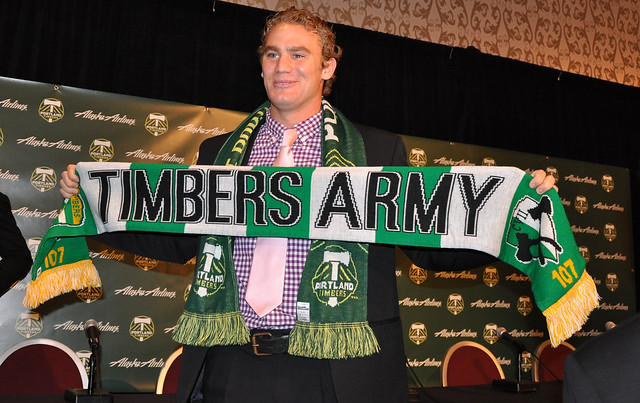 Another ancient tradition in covenantal relationship is the exchange of names. Here, an individual also takes on another identity. In ancient Hebrew tradition, the name for God was often added to the name of an individual who embraced or believed in God. For example, Abram becomes Abraham and Sarai becomes Sarah as they enter into covenant relationship with God. It is not uncommon to hear supporters in the stands declaring that they are part of the team, that they are one with the players that are out on the field. The scarf is an item that also becomes an adoption of a unique name that unifies individuals into a common people.
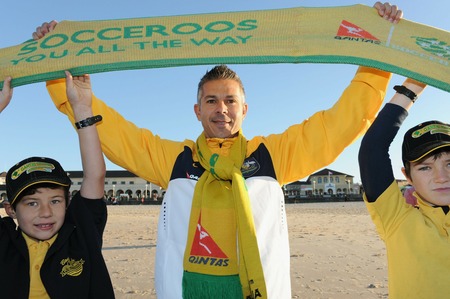 But perhaps the most telling ancient tradition that most closely represents the tradition of the scarf is the covenant cut. In ancient times, two people making a blood covenant, would make a cut on the wrist. They would then shake hands and let the blood co-mingle representing that two lives were becoming one. As time passed, the way that one would identify people of the covenant would be with the raise of the hand which revealed the scar. This is where the practice of waving the hand and exposing the wrist in greeting and also in oath-taking may have evolved from.
So, the next time you take in a soccer game and see the supporters scarves raised in a wall of support consider the testimony that is behind that activity and consider the long history behind that – it is a history that includes the action and activity of a God looking to enter into relationship with his people. It is the work of people of promise, of people of the covenant, people that identify with God and God identifies with them, too.
Blessings,

Rev. Brad Kenney
 Toronto FC, at one time one of Major League Soccer’s bright stars, has reached an embarrassing low. Starting the 2012 season with a league record of 0-8, the Toronto club has yet to get a win, or even a draw (tie), for any points on the season. The accompanying sense of frustration from the losing streak is one of the places where chaplains are often called to minister and speak into – sometimes with mixed results.
 No team likes to begin the season in a deep hole. And no team wants the dubious distinction of being one of the most ineffective or hapless teams of all time. Although, the Detroit Lions, at 0-16 in 2008 (the sum total of all league games for one season in the National Football League), will probably carry the distinction of being perhaps the worst team in modern sporting history for many years to come.
 So a typical question that people ask is, “Does God really care?” (about sports, results, wins, etc.). Serving as a chaplain for a professional sport team for over 10 years, I have wrestled with this question often. What has been helpful for me is the example from the life and ministry of Saint Patrick. He would enter into a village and share the Good News of Jesus, and during the week he (and his team) would go out with the villagers and pray over and bless the streams (to produce fish) and for the fields (to produce crops) and for the woods (to produce game). Patrick realized that in praying for “our daily bread” involves how food gets put on the table. For the athlete, this means having success in their work, in their profession.

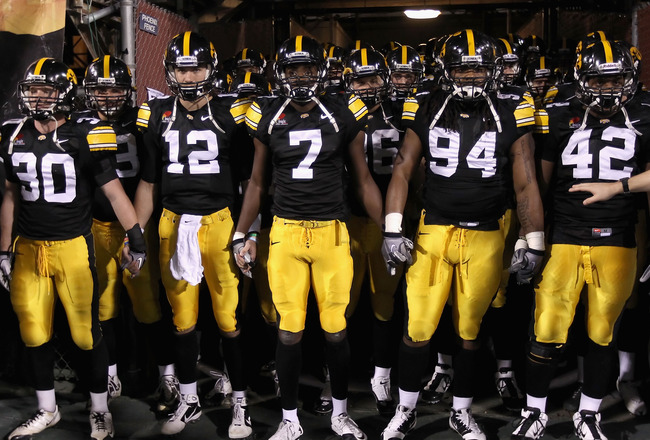 Consider this: a National Football League team has 53 players. There are 11 on the field at a time – and usually there is little duality of roles (i.e. offensive players and defensive players do not mix). The resulting 22 “starters” leave another 31 on the sidelines, but there tend to be many ways for players to have specific roles (special teams, etc.) with an NFL team and are still able to play and contribute. There is no limit to the number of substitutions that can be made during an NFL game- only to the amount of players (46) that can dress on game day. So potentially, there are seven players that may not see action on game day. Statistically speaking, 13% of your roster that you have to try and keep satisfied, motivated.
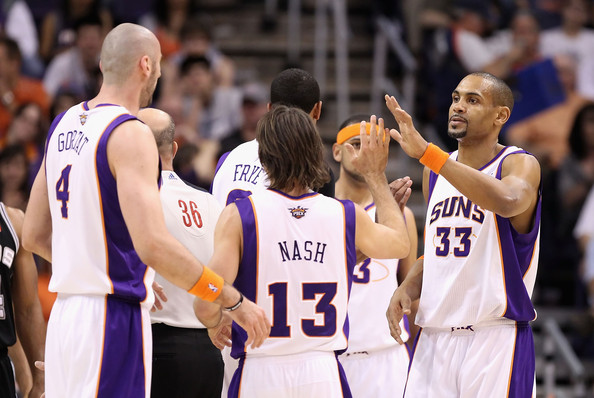 A National Basketball Association team can have 15 players signed and practicing with a team, but can only dress 12 for an NBA game. There are five players on the hardwood for a team at a time, unlimited substitutions and flexibility of roles within a team make for the chances of each player being able to get some time playing the professional game that they are passionate about. The three players that do not dress, equals 20% of a ‘roster’ though the NBA is similar to the NFL in that they often designate these players as “practice squad” players.
 The National Hockey League is similar to the NBA, but with more players on the roster. 23 players can be with the club, but 20 (18 skaters and 2 goaltenders) are dressed for gameday. The speed and pace of the game means that there are many substitutions (again, unlimited) and the 6 players (5 skaters and 1 goaltender) on the ice at a time allow for full participation of players in the game (coaching decisions, penalties, and situational circumstances aside). The three players excluded from game day represents 13% of the roster – again, keeping these players fit, motivated, and satisfied represent a challenge for the coaching staff.
 Major League Baseball has a different system. There are 25 players on an active roster (an additional 15 players are on an expanded roster which has injured players or farm team players). With 9 players on the field at a time (the American league has an additional player hitting for the pitcher) there are unlimited amount of substitutions that can be made, but there is a limit to this as many of the roles in baseball are situational. Teams carry different loads of positional player to pitcher ratios (usually 12 pitchers and 13 positional players on an active roster) but if we merely look at the game-day roster of 23 and assume that there are 13 position players that could be substituted for 8 positions (excluding the pitcher) this leaves 5 that may not see game time (not including situational pitchers). But the sheer number of games in MLB (162) means there is plenty of opportunity for players to play. So, roughly, 22% of a MLB team waits in the wings.
 Major League Soccer teams carry rosters of 30 (with some exceptions). Of this number, 18 dress for 11 positions on the pitch (field). However, competition rules limit the number of substitutions to 3 players. This means that in any given game (34 league games in a season) at most 14 players can compete. Games are timed (like in football, basketball, hockey) but there is no stoppage of the clock. 90 minutes for 14 players out of 30 means that more than half of your team is not seeing a minute of playing time (limited as it is) and among professional sports leagues, only the NFL has fewer games than MLS.
 When David Beckham first stepped foot on American soil to play for Major League Soccer, there was a division of opinion. Some said Beckham was merely the latest in a long line of world-renown footballers, past their prime, looking to make a last stab at financial gain before retirement. There were other pundits who claimed that soccer had officially made it in America and that the Beckham brand would forever change the American landscape and attitude toward a sport with a sketchy history of attraction in the U.S.A. Now, five years later, the jury may still be out on many points of the argument but there is at least one thing (there are more) from this chaplains perspective that Beckham’s arrival did for Major League Soccer. I call it “The Beckham Affect.”
 Change #2 – Legitimacy – Beckham’s first few years were a mix of success and failure – at one point there was heavy criticism for the amount of money he was being paid for the number of minutes he was on the field and producing seemingly little results. However, last year’s MLS Cup Final win over Houston and Beckham’s subsequent return and renewed contract may have stemmed the tide of opinion against him. Beckham’s presence, though, did open the door for other, high-profile players to come and ply their trade in MLS. Although some still may view MLS as a pre-retirement destination, the league has grown in popularity and legitimacy in the years that Beckham has been in the league and looks to continue to grow in an upward trend.
 Change #3 – Money – Beckham is an oft-critisized personality. Some have made fun of his seemingly un-sharp comments at times, but he has a lot of respect in terms of his personal branding and marketing. MLS has benefitted from the Beckham brand – a healthy and in-form Beckham is sure to help the local team sell out for the LA Galaxy game when the Beckham show hits the road and this means people in the seats to see the world-famous star. General Managers like to have their stadiums fill to capacity.
 In the hours immediately following last April’s injury, Zakuani was at risk and needed surgery immediately to relieve pain and pressure from the break. I know many on the Sounders were holding their breath – this was their prized draftee and a promising young player; career, even life seemed to hang in the balance. Mullan had no idea of the extent of the injuries until the game was finished and he was heading home.
 For those that know Mullan, he’s a wily veteran with an extensive playing career, but ‘dirty player’ is not a title that would be used in the same sentence for one of two players in the league to have earned five championship rings. He joined the Rapids to help them win the coveted Major League Soccer Cup, and that he did in his first year with the club.
 Fast forward to today, the return trip to Seattle and one of the most difficult places to play in the league – but when 38,000 fans are ‘booing’ you every time you touch the ball, it can seem a lot more. I did feel that the fans were professional enough – any team will ‘boo’ the villan. I was wondering if there would be more pugilistic kinds of threats or danger toward Mullan, but it seems that the game went without incident in any sort of regard to that direction – although there will always be extreme fans
  Personally, though, there is some disappointment for me as the Rapids team chaplain. Perhaps I am too idealistic. Perhaps I am too romantic. Perhaps my desire for the beautiful, storybook ending just isn’t to be hoped for. I had imagined Brian Mullan walking over to Steve Zakuani at midfield, with the entire of Seattle watching as the two shook hands, hugged, and forgiveness and grace at center stage with tears and confetti while the Sounders faithful sang a new hymn of football reconciliation. But such things were not to be today – but maybe another day. We can only hope and pray.