
 A friend recently lost his job. Terminated without any warning, he expressed shock and dismay when the company that he had worked for over 8 years told him, “We’re going in a different direction.” Box in hand, he cleared out his desk and made his way home – bewildered and confused while coworkers looked on. Whilst we don’t often consider it in this way – a death had occurred. Relationships, pay, significance, identity, and much more all were “killed” in that particular moment for my friend and he had to cope with a great sense of loss that was compounded by the whole thing being confusing and unforeseen.
 Losses like this are commonplace in life and also in professional sport – being traded or cut, a career-ending injury, or a personal trauma all represent a type of “death” that one can experience in the course of one’s professional career. In the midst of the dying process, as human beings, we search for redemptive and hope-filled moments – we await the next offer or opportunity, we hope for change or something different to come along.
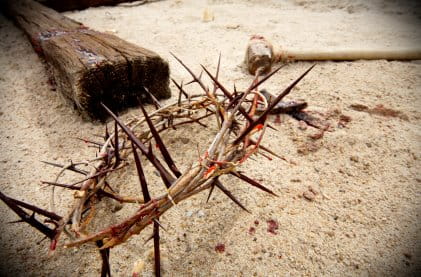 When that new thing does come along it is almost like experiencing a “resurrection” of the soul. The sun shines clearer, we can see purpose in our situation, we are filled with a new found sense of hope. This Easter Sunday, as Christians, we reflect on the Ultimate Death and Life in Jesus Christ. The brutality of Friday’s crucifixion and the death – of Christ, and seemingly of so many others things (relationships, hopes and dreams) that occurred was heavy. Perhaps the heaviest time ever in the span of history, but Sunday was coming.
Friday’s death and darkness was blown away by Sunday morning’s victorious discovery: that Jesus was, indeed, alive again. In fact, Jesus revealed that man (who had been dead since the Garden) could now have life again. The weight of the world was lifted in one fell swoop.
 No matter where you are right now – whether approaching a seeming death, in the throes of pain and suffering, or just plain “dead” – you can have life again. Cry out to God – he has not abandoned you or I. He has the power to raise dead things to new life again. And he will do it – for you and for me.
Last week, the same friend that lost his job, made a connection with another member at my church. Knowing that they were in similar fields I introduced them through LinkedIn and they met at church. A few interviews later and my friend called me to say he received a job offer that he was intending to accept. It wasn’t three days of waiting (it had been three weeks – though) but he and his family are experiencing life again. To the glory of God.
Blessings,

Rev. Brad Kenney


 First, making a distinction between superstition and rhythms can be helpful. There are some things that players, coaches, or teams out of superstition and there are other things that a team does in order to develop a rhythm or pattern. For example, warming up before a game with exercises and drills is more of a pattern than a superstition and a way of preparing the body for the task. In a similar way, an individual player may have their own pattern of preparing for a game – from taking a nap, to reading, to even praying. Sometimes, a rhythmic action can become superstitious (for example, a player who prays before a game having success and then determining that the prayer is what made him successful). This is an area where a chaplain must provide clarity and insight.


 But regardless of the athlete and the environment of academics that they come from, one of the roles of the chaplain in professional sport is
  If helpful at a collegiate level, you can imagine how much more helpful at a professional level. I am coming to realize more and more, that some of my work as a chaplain is to help the young men that I work with to become more solid in life and not just in academics, but in life and faith. Part of my role is helping them in the process of going from boyhood to manhood. Helping them to become real men – men of integrity, men of faith, men of honor, men of valor – men that are not, paper thin.
 Whilst scanning the Twitterverse a few weeks ago, former Colorado Rapids Forward Andre Aukpan (@auakpan), now with New York Red Bulls, highlighted a story on the National Football League’s
  First, with the popularity of sports in modern-day culture, many young athletes can feel trapped – they have sometimes abandoned education for the sake of entering sports early. Young athletes have many times even missed out on typical social and mental growth and well-being (sports taking primary importance in life). In some cases, they have missed crucial developmental stages or “rites of passage” moments for the sake of the sport. When it comes time for the end of a career – many can feel trapped because the sports world is all that they have known, all that they have invested in.


 Firsts. This season, the Colorado Rapids will encounter many firsts – moments where the team and organization find themselves as never before. For example, 2014 is the first season that the team is being coached by a former player (
 As a chaplain, much of my role is to remind people of
 I had the privilege of attending portions of the recent ID camp held for Colorado high school student athletes at Valor Christian High School this past week. The camp was put on to give students and college coaches an opportunity to be observed in hopes of receiving scholarships or invitations for possible openings on college teams. Of the 100-some students and 25- some college coaches participating in the event, there was an air of anticipation and hope – perhaps this might be an opportunity to receive an offer from a college to study and play the sport that they had come to love.
 As I reflected further, I was reminded of the life of Jesus and his own ID’ing that took place as he set out to begin ministry. We read in Luke 6:12 that Jesus spent some intentional time praying to God before he chose the twelve men that would walk closest with him while he was here on earth (maybe you are thinking about the 11 true apostles – but I am not trying to make soccer team parallels here, honest). From history, scholars surmise that these apostles and disciples that Jesus called were probably young men – maybe even teenagers, who having not made the grade for further religious instruction were settling into life as tradesmen (fishermen, tax collectors and more).
 Of course, as team chaplain, I see similar moments when professional athletes and coaches and staff face decisions that are seemingly monumental – choices about career, family, retirement, contractual negotiations, and other life issues can be difficult to discern and choose the correct path. These are moments – moments when we are looking toward the future – that we ought to seek God. We need to find mountain top moments and spend nights praying to God about what we ought to do. And in those spaces, we need to listen and hear the voice of God so that we might make wise choices, wise decisions because we cannot accurately ID the future on our own.
 If you know anything of the Greek word uses for love – there were four: