
 Whilst scanning the Twitterverse a few weeks ago, former Colorado Rapids Forward Andre Aukpan (@auakpan), now with New York Red Bulls, highlighted a story on the National Football League’s Rashard Mendenhall retiring at the age of 26. The story (written by Mendenhall) presents a odd perspective that rarely exists in professional sport these days. To understand that the world sees him more as an entertainer, and to make a decision not to continue to punish his body for the sake of entertainment shows a depth of wisdom and insight for someone as young as Mendenhall. While perhaps not a player with the same professional athletic achievements as Mendenhall, Rapids defender Kory Kindle’s retirement earlier this year was along the same vein. What is one to make out of young men seeking to leave professional sports – in spite of potential earnings or achievements that might still be gained? I believe it is a good thing on several accounts…
 First, with the popularity of sports in modern-day culture, many young athletes can feel trapped – they have sometimes abandoned education for the sake of entering sports early. Young athletes have many times even missed out on typical social and mental growth and well-being (sports taking primary importance in life). In some cases, they have missed crucial developmental stages or “rites of passage” moments for the sake of the sport. When it comes time for the end of a career – many can feel trapped because the sports world is all that they have known, all that they have invested in.
Second, it is rare to find what I call the “prepared athlete.” There is so much superstition built into sports psychology today that many players believe something along these lines:
If I think about what is next after sports, I will automatically lower my ability to achieve something higher because of my mentality. I can only focus on being an athlete.
Thus, many athletes find themselves in a critical state when the moment to retire or leave the sport comes (whether by their choice or not) because they have not thought much about who they are, the abilities they have, or the passions they have outside of the sports world. This is especially dangerous for professional athletes who make less money (although some might argue that the lower pay scale may actually help keep them in touch with reality) – if they haven’t given consideration to what lies beyond professional sport they often find themselves at a disadvantage when it comes to continuing their education or finding work.

Scottie Pippen lost significant amounts of money with poor financial dealings.
Finally, we have seen many examples of professional athletes that have mismanaged or been poor stewards of the exorbitant amounts of money that they have received – from boxing stars like Mike Tyson, to National Basketball Association players like Scottie Pippen – many athletes make poor financial choices. In fact, some have said that 80% of National Football League players are filing for bankruptcy 2 years after finishing playing the sport.
It is because of these particular reasons, that I find my work as a chaplain (and our intentional focus on holistic care) must necessarily include encouraging wisdom and growth towards the post-career choices that athletes (and coaches) must sometimes make. Whether by utilizing career or personality testing or providing vocational counseling or referring them onto more specific, professional resources I have found it increasingly important to have open dialogue with the players that come and play for the teams that I serve – from high school students to the professional athletes. When I see a player calling it quits and walking away from the game with preparation and confidence, I breathe a little easier knowing that they will not have to face as much of the pain of retiring early as some of their compatriots.
Blessings,

Rev. Brad Kenney


 Firsts. This season, the Colorado Rapids will encounter many firsts – moments where the team and organization find themselves as never before. For example, 2014 is the first season that the team is being coached by a former player (
 As a chaplain, much of my role is to remind people of
 I had the privilege of attending portions of the recent ID camp held for Colorado high school student athletes at Valor Christian High School this past week. The camp was put on to give students and college coaches an opportunity to be observed in hopes of receiving scholarships or invitations for possible openings on college teams. Of the 100-some students and 25- some college coaches participating in the event, there was an air of anticipation and hope – perhaps this might be an opportunity to receive an offer from a college to study and play the sport that they had come to love.
 As I reflected further, I was reminded of the life of Jesus and his own ID’ing that took place as he set out to begin ministry. We read in Luke 6:12 that Jesus spent some intentional time praying to God before he chose the twelve men that would walk closest with him while he was here on earth (maybe you are thinking about the 11 true apostles – but I am not trying to make soccer team parallels here, honest). From history, scholars surmise that these apostles and disciples that Jesus called were probably young men – maybe even teenagers, who having not made the grade for further religious instruction were settling into life as tradesmen (fishermen, tax collectors and more).
 Of course, as team chaplain, I see similar moments when professional athletes and coaches and staff face decisions that are seemingly monumental – choices about career, family, retirement, contractual negotiations, and other life issues can be difficult to discern and choose the correct path. These are moments – moments when we are looking toward the future – that we ought to seek God. We need to find mountain top moments and spend nights praying to God about what we ought to do. And in those spaces, we need to listen and hear the voice of God so that we might make wise choices, wise decisions because we cannot accurately ID the future on our own.
 If you know anything of the Greek word uses for love – there were four:
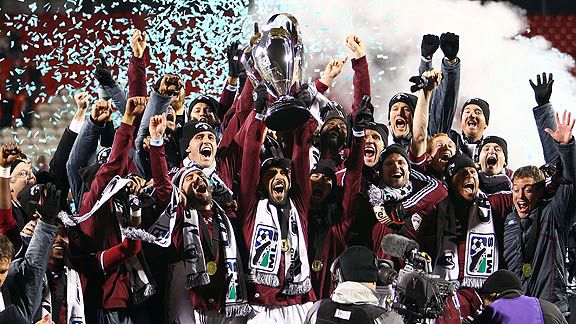 Part of my personal experience with this was when the Colorado Rapids won the Major League Soccer Championship game in 2010. I was there, on the field, as the players and coaches their families and the fans celebrated the first championship in team history (still one of only two championships to come to Colorado since those ’98 Broncos – National Hockey League Av’s in 2000-1 being the other). It wasn’t 45 minutes after leaving the field that coaches were having to determine which players on the roster would be unprotected for the MLS expansion draft – players didn’t even get to celebrate the championship before being told that they might be traded or waived.

 The Colorado Rapids have been in the news of late, particularly over the situation with the head coach, Oscar Pareja. For the last couple of months, there have been stories that surface about Pareja’s pursuit by his former club FC Dallas. Beginning in November of 2013,
  On the last day of 2013, there is occasion to pause for reflection. There is much debate around looking backward in order to move forward in our culture. Some criticism – that the only reason we look back is so that we can make more efficient our practice or modernize our mechanistic attitude. Some wisdom – that we ought to learn from mistakes and strive to not repeat them, to teach our children how to overcome them. Some practical application – goal-setting, resolutions, and the like. Some fantastical dreaming – see above.